

My article on a Middle Eastern family buying a major Bible publisher gained a lot of traction over the past two weeks, and some accusations of being complacent, lazy and sloppy. The fact is that I wasn’t claiming anything as much as recording the fact that the rumor existed. Someone else said that everyone involved had signed non disclosure agreements, and that was why there was no evidence.
Saying that it was on social media doesn’t make it true. I might not be the sharpest knife in the kitchen, but having been on, and written about social media for over two decades, even I know not to trust everything that I see there.
At a guess, I would say people fear the Bible might be corrupted, or changed in some subtle way that moves it away from the original text and meaning. Many Muslims claim that the Bible has been corrupted, so it would be logical to think that maybe it could be changed.
In fact, in the Quran several passages accuse some Jews or People of the Book of altering words, concealing things, writing something and claiming it came from God, or twisting Scripture in their speech—commonly cited passages include Qur’an 2:75, 2:79, 3:78, 4:46 and 5:13. These became the foundation for later Muslim discussions of “ta?r?f”. Source: Centre For Muslim-Christian Relations
So yes, I understand where that fear comes from.
But understanding where that fear comes from still isn’t evidence that the alleged sale occurred.
Speaking of worrying about the Bible being changed, or altered, readers should be encouraged to do a little investigation of their own into existing translations.
For example, controversy surrounding the New International Version, particularly the 2011 revision, concerns its use of gender-inclusive or “gender-accurate” language. Where the original Hebrew or Greek refers to people generally, the NIV will sometimes render traditionally masculine English expressions such as “brothers” as “brothers and sisters,” or use plural pronouns rather than a generic “he.”
Critics, most prominently some conservative evangelical and Southern Baptist groups—have argued that this sometimes moves beyond translation into interpretation and can obscure masculine wording that may be significant.
The Southern Baptist Convention formally criticised the 2011 NIV on those grounds.
Defenders respond that the purpose isn’t political correctness but accurately communicating in contemporary English when the original clearly includes both sexes. Source: Christianity Today.
Controversy today also centers around translations like “The Passion”
Brian Simmons, a former missionary, is the lead translator of The Passion Translation (TPT). However, his credentials and methods have become controversial, with Wycliffe disputing descriptions of Simmons as a translator or co-translator of the Kuna New Testament, saying his role was an unofficial comprehension checker rather than linguistic analysis or translation.
Scholars have also challenged his handling of Aramaic/Syriac; notably, Simmons himself acknowledged to NIV scholar Mark Strauss that he is “not an Aramaic scholar.”
These concerns matter because a translation should ultimately be judged by how faithfully it represents its source texts, not by the translator’s claimed spiritual authority.
Pastor Mike Winger covers this in more detail here:
So what should we do?
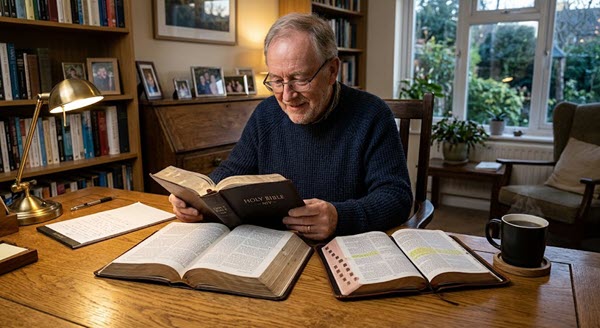
As I said in my original article, get a physical Bible, and another to compare it with. And read it, daily if possible. That way you will get to know what it says, and how it relates to you. I meet with a group of friends on a regular basis, and we take turns reading scripture from different versions, discussing and praying about them. Are we Biblical scholars? No, and we don’t claim to be. We are seeking after truth.
Speaking of truth, in John 14:6 Jesus says: “I am the way and the truth and the life. No one comes to the Father except through me.” If you want the truth, as The Truth, Jesus to come into your life, and lead you to where He wants you.
About Coffee With Allan
Coffee With Allan is a place for conversation about Life, the Universe and Everything. The conversation continues, from 2007 to...
 You can also find more of my writing at
The Life.
You can also find more of my writing at
The Life.